
The tension between people and wildlife is as old as settlement itself. A tiger that crosses into farmland at night. An elephant herd that flattens a season’s crop in an hour. A leopard spotted in the lane behind a village school. For hundreds of millions of people living on the edges of India’s forests, this is not an abstract conservation concern. It is every morning.
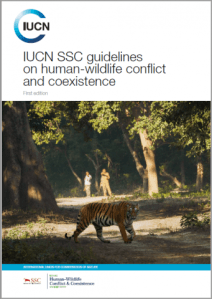
Now, for the first time, there is a globally agreed framework for how to think about it — and, more importantly, how to act.
A global reference, finally
The IUCN Species Survival Commission has published its Guidelines on Human-Wildlife Conflict and Coexistence, the first document of its kind to provide a universal set of foundations and principles for managing conflict between people and wildlife. Developed by the IUCN SSC Human-Wildlife Conflict and Coexistence Specialist Group, the guidelines are designed for use by conservation practitioners, community leaders, government officers, researchers, and decision-makers — anyone, in short, who has to navigate the moment when a wild animal and a human being want the same piece of land.
The guidelines are deliberately species-agnostic and geography-neutral. They don’t tell you what to do with a specific tiger in a specific forest. They offer something rarer and more durable: a principled approach — holistic, collaborative, and grounded in the social, cultural, and economic realities of the communities involved.
Originally published in English in 2023, the document has since been translated into French, Portuguese, Russian, Spanish, and Arabic. The latest milestone is the launch of a Swahili edition — a significant step for East and Central Africa, where human-wildlife conflict is among the most acute in the world. German, Chinese, Amharic, and Persian translations are currently in preparation.
Why India needs this conversation
Few countries have more at stake in getting this right than India.
The numbers are stark. According to the State of India’s Environment report, elephant attacks killed 629 people in 2023–24, up from 464 in 2020–21 — a rise of approximately 36 per cent in four years. In Uttarakhand alone, leopards have killed 534 people since the state was formed in 2000. In Kerala’s Wayanad district — one of the most conflict-prone regions in the country — 450 human-wildlife conflict incidents were reported in a single year. A 2026 study in the Western Ghats found that 90 per cent of farmers surveyed named wildlife conflict as their primary production risk.
The picture on the other side of the equation is equally troubling. In 2023–24, 94 elephants died from electrocution by illegal live wires. In Bandhavgarh Tiger Reserve alone, four tigers died from electrocution between November 2025 and early 2026. The 2026 State of India’s Environment report notes that as tiger populations reach saturation inside reserves, animals are increasingly ranging into lantana-dominated patches outside protected areas — with too little prey, and too many people.
This is a system under pressure from both sides.
Not a new problem, but a newly framed one
India has not been without policy responses. The Ministry of Environment, Forest and Climate Change released species-specific guidelines covering elephants, leopards, snakes, and others in 2023. Project Tiger and Project Elephant both have habitat improvement and conflict mitigation components. States like Odisha have introduced early warning systems — the Surakshya app notifies communities of elephant movements in near real-time.
But policy and practice have struggled to keep pace with the scale of the problem, and compensation mechanisms remain slow and uneven. The IUCN framework adds something that national-level policy often lacks: a common language and a shared set of principles that allow local practitioners, state governments, NGOs, and communities to work from the same baseline.
The emphasis on community engagement is particularly relevant for India. The guidelines stress that conflict management must account for underlying social, cultural, and economic contexts — a recognition that a farmer who has lost half her crop to a herd of elephants is not simply a conservation stakeholder to be managed, but a human being whose interests must be treated as legitimate.
A framework worth reading
The IUCN guidelines are available as a free download in all current languages at hwctf.org/guidelines. For forest officers, conservationists, policymakers, and anyone working at the difficult boundary between India’s wild spaces and the communities that live alongside them, it is a document worth knowing.
The conflict between people and wildlife is not going away. If anything, as India’s tiger and elephant populations grow and forest edges become more crowded, it is going to intensify. The question — as the IUCN guidelines frame it — is not how to eliminate conflict, but how to build the conditions for coexistence.
That is a harder, longer, and more honest goal. But it is the right one.
Sources: IUCN SSC Guidelines on Human-Wildlife Conflict and Coexistence; IUCN; State of India’s Environment 2025 & 2026 (Centre for Science and Environment / Down To Earth); Mongabay India; The Quint.
 indiawildlifenews.com