
The jeep safari is India’s most popular wildlife experience. It is also, increasingly, one of its most troubling.
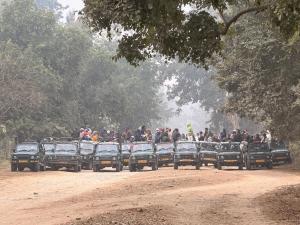
The photographs above were taken recently at the Phato zone in Uttarakhand’s Corbett Tiger Reserve — the Uttarakhand registration plates on the Gypsies give it away. The scene, however, will be instantly recognisable to anyone who has visited a major Indian national park in the last decade. Fifteen, perhaps twenty, open-top Gypsies, packed to standing with visitors, arranged in a rough semicircle on a dusty forest track. Somewhere beyond the wall of vehicles and craning necks, presumably, is a tiger.
The view from inside
A visitor who witnessed the scene firsthand — and whose photographs accompany this piece — described arriving at a sighting full of the usual anticipation: the misty sal trees, the alarm calls of deer, the possibility of something extraordinary. What greeted them, when the sighting was reported and their driver put his foot down, was a traffic jam. Not a metaphorical one. An actual, jostling, petrol-fume traffic jam, in the middle of a tiger reserve.
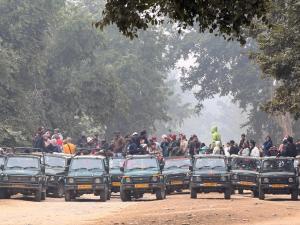
The tiger, if it was there at all, was invisible behind the scrum. What was entirely visible was the absurdity of the situation: dozens of humans who had come to experience the wild, collectively ensuring that the wild was nowhere to be found.
“A death warrant”
A post on Threads by the user @bright._bharat put it with some force: “We’re bullying an apex predator for a photo op. By trapping tigers in ‘safari jams,’ we’re backing them into a corner. If they snap, they’re labeled ‘man-eaters’ and sentenced to cages or death. It’s not tourism; it’s a death warrant.”
The language is pointed, but the concern is well-founded and increasingly shared. In February 2026, a video from Ranthambore’s Mishri Darra gate went viral after Dr PM Dhakate, a Senior IFS Officer and Chief Conservator of Forests, brought it to wider public attention. The clip showed a tiger stopped mid-path, surrounded by safari vehicles, vocalising with visible stress — a low growl that the vehicles around it chose to interpret as a photo opportunity rather than a warning. The vehicles did not move.
This is not an isolated incident. It is a pattern.
What the stress actually does
Wildlife biologists are unambiguous on this point. Tigers are territorial, solitary, and acutely sensitive to disturbance. A tiger forced to repeatedly navigate a gauntlet of idling Gypsies and jostling tourists is a tiger under chronic physiological stress. Elevated cortisol levels affect hunting behaviour, breeding patterns, and territorial stability. Habituation — the state in which an animal stops fearing humans — is often misread as calm; it is in fact a precursor to unpredictable behaviour.
And when a stressed, habituated tiger eventually acts in a way that injures a human — even in circumstances any ethologist would classify as provocation — it is the tiger that is labelled a man-eater and removed from the wild.
The numbers behind the jam
India’s tiger tourism has grown substantially alongside the successes of Project Tiger. Ranthambore, Corbett, Kanha, Bandhavgarh, and Tadoba together receive millions of visitors annually. Safari permits are a significant revenue source for state forest departments and buffer-zone communities alike. The incentive structure pulls strongly in one direction: more vehicles, more permits, more money.
The Supreme Court attempted to intervene as far back as 2012, directing the National Tiger Conservation Authority to demarcate core zones and cap vehicle numbers. Compliance has been uneven at best. Ranthambore formally banned mobile phones on all safaris from 30 January 2026 — and the Mishri Darra incident, with tourists filming on smartphones, occurred three weeks later. A rule that exists only on paper is not a rule.
The thin line
None of this is an argument against wildlife tourism. The case for it is real. Safari revenue funds anti-poaching patrols, sustains local economies, and gives forests an economic value that competes with agriculture and development. A tiger worth money alive is a tiger less likely to be poisoned by a farmer protecting his cattle.
The question is not whether to have wildlife tourism. It is what kind.
Responsible operators maintain strict distance protocols, limit vehicle numbers at sightings, and brief guests before entry. Some lodges in Corbett and Tadoba operate with genuine restraint. But they are outnumbered, in most popular parks, by those for whom the sighting is the product — and the tiger’s stress is an externality that doesn’t appear on the invoice.
What would better look like?
Some models are worth examining. In Kenya’s Maasai Mara, voluntary codes of conduct enforced through peer pressure and guest expectations have reduced vehicular harassment of big cats. In South Africa’s private reserves, single-vehicle exclusivity at sightings is standard practice. Neither translates directly to India’s context, but both demonstrate that the balance between access and protection can be struck very differently.
Within India, conservationists have proposed tiered permit systems — a small number of low-disturbance safaris in core areas, and higher-volume access in buffer zones with tighter enforcement. Others advocate for the NTCA to actually enforce the guidelines that already exist, which prohibit the kind of massed convergence shown in these photographs.
The images from the Phato zone that morning are not unusual. That, precisely, is what makes them worth publishing.
Photographs by the author. Post by @bright._bharat on Threads referenced with attribution; full name not publicly available.
 indiawildlifenews.com