
IWN Series: Antlers & Antelopes of India — Part 2
In the dry deciduous forests of peninsular India, something walks on four legs, weighs about as much as a medium-sized dog, and carries on its head an arrangement found on no other living animal on earth: two pairs of horns.
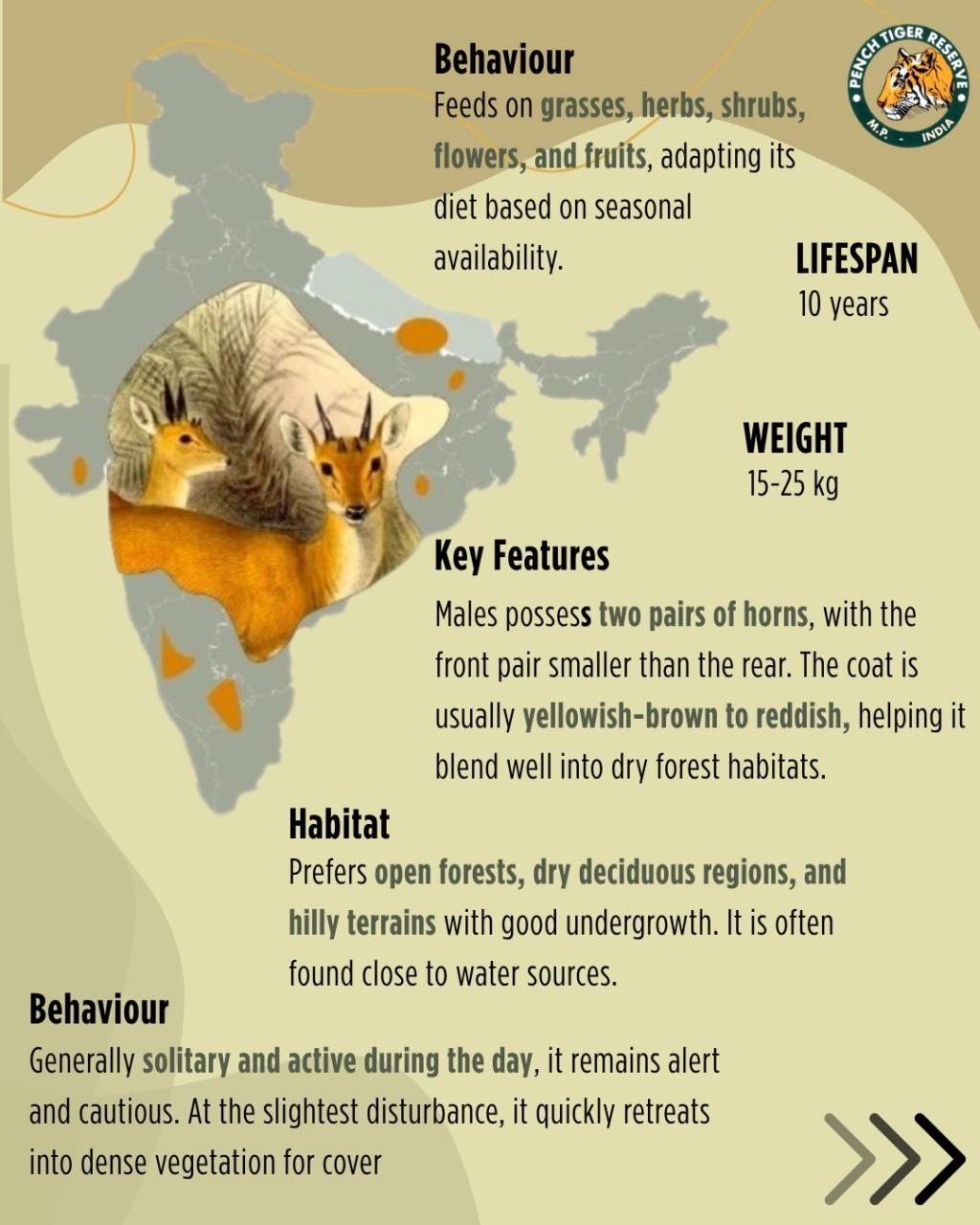
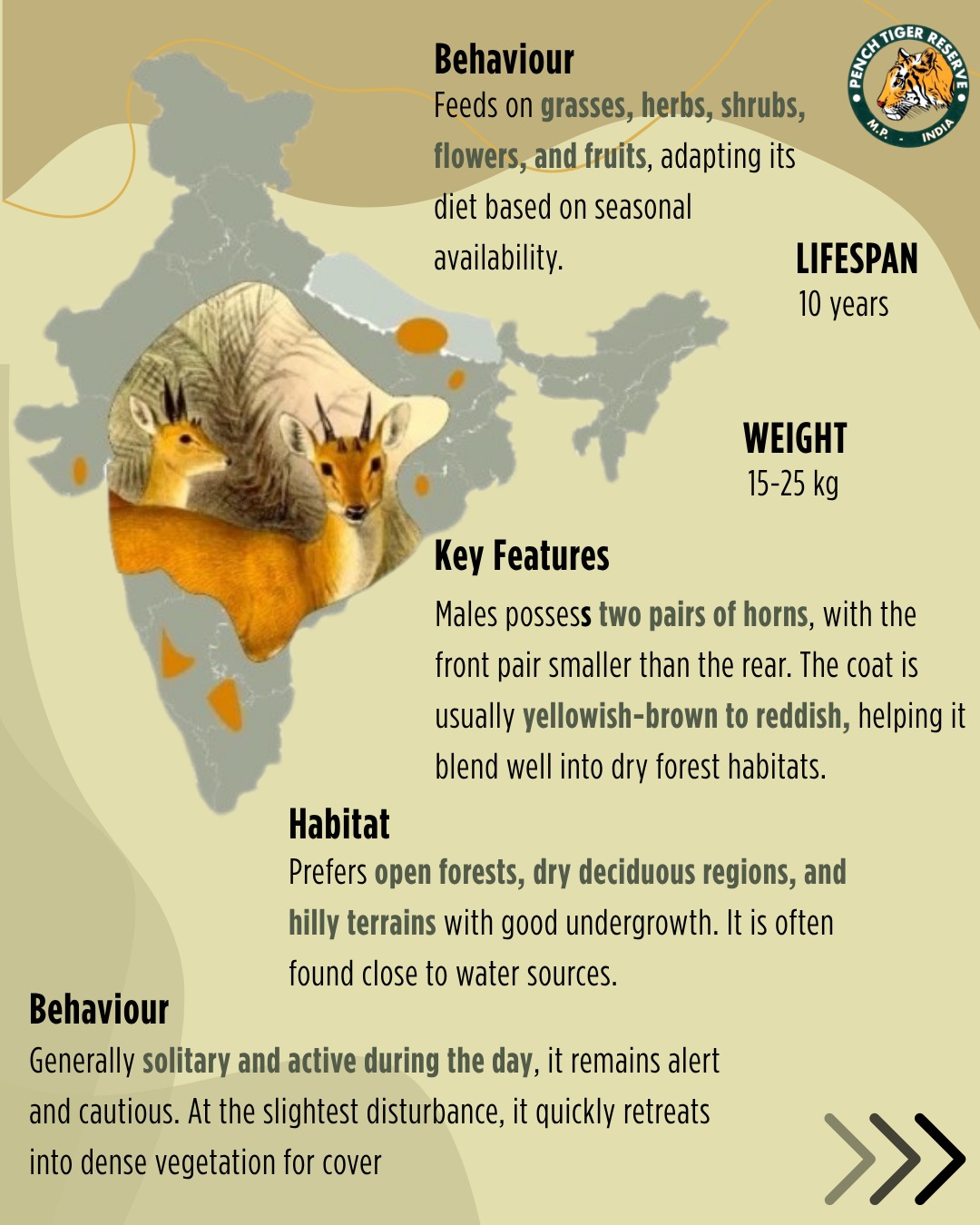
The front pair is small — sometimes just short stubs. The rear pair is longer, typically 8–12 centimetres. Both pairs are permanent, unbranched, and found only on males. No other bovid — not buffalo, not goat, not cattle, not any of the world’s 140-odd antelope species — grows four horns. The Chousingha, or four-horned antelope (Tetracerus quadricornis), does it alone.
What it is
The Chousingha is a small antelope, weighing between 15 and 25 kilograms, with a yellowish-brown to reddish coat that blends well into the dry forest floor. It is generally solitary and diurnal — active during the day, though cautious enough that at the slightest disturbance it retreats immediately into dense vegetation. Its diet shifts with the seasons: grasses, herbs, shrubs, flowers, and fruits, taken according to what the forest offers at any given time of year. Its lifespan in the wild is around 10 years.
The four horns that make it biologically extraordinary are not fully understood. The front pair, smaller and sometimes vestigial in some individuals, may play a role in intraspecific combat — males using both pairs when fighting rivals. Whatever their function, they are unique enough that the species’ scientific name simply means “four-horned.”
Where it lives
The Chousingha is found only in India and Nepal, making it one of the few large mammals truly endemic to the Indian subcontinent. Within India, it prefers open forests, dry deciduous landscapes, and hilly terrains with good undergrowth, usually within reach of a water source. It is distributed unevenly across peninsular India — across Madhya Pradesh, Maharashtra, Odisha, Andhra Pradesh, and parts of Rajasthan and Gujarat — but nowhere in large numbers.
Pench Tiger Reserve in Madhya Pradesh is among its reliable habitats. It is also found in several other central Indian reserves, including Tadoba, Melghat, and Satpura.
Conservation status
The Chousingha is classified as Vulnerable on the IUCN Red List. Its primary threats are habitat loss — the dry forests it depends on are among India’s most heavily degraded — and hunting. As a small, solitary animal with no herd protection and limited speed, it is particularly susceptible to snaring. Livestock grazing competes with it for undergrowth, and its preference for areas near water makes it vulnerable wherever human settlement expands along riverbanks and forest edges.
Population estimates are uncertain; the species is rarely the focus of systematic survey effort, which is itself a measure of how little attention it receives relative to India’s more charismatic fauna.
The animal you’ve never heard of
The Chousingha appears on Schedule I of India’s Wildlife Protection Act, 1972 — the same schedule as the tiger, the elephant, and the snow leopard. In legal terms, it carries the highest possible protection. In practice, it remains one of India’s least known wild animals: absent from most safari wishlists, rarely photographed, and seldom mentioned in conservation coverage.
That is partly a function of its size and its solitary, retiring habits. It is also, perhaps, a function of how conservation attention tends to concentrate on the spectacular and the large.
The four-horned antelope is neither large nor spectacular in the conventional sense. It is, however, the only animal on earth that does what it does — and it does it in India’s dry forests, quietly, alone, carrying its improbable crown of horns into the undergrowth.
Next in the series: Part 3 — The Barasingha, Kanha’s miracle deer.
Sources: IUCN Red List — Chousingha · Pench Tiger Reserve · Wildlife Institute of India
 indiawildlifenews.com